Product
Execution workflows as a category
Execution workflows as a product category
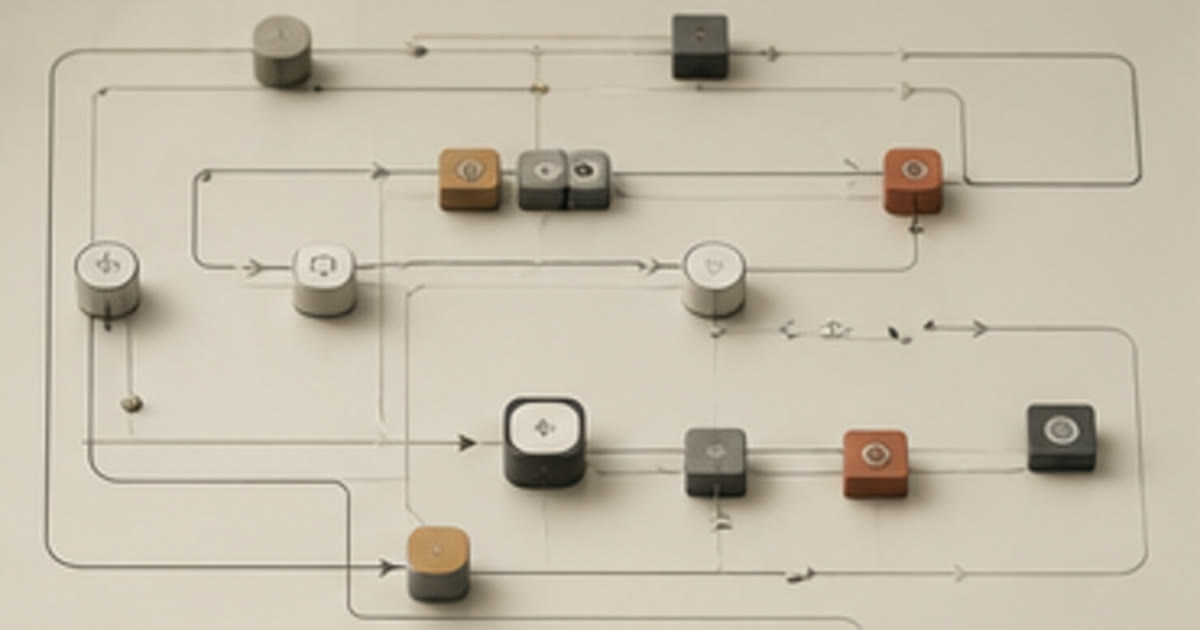
The thing that keeps breaking
There is a particular type of failure that does not appear in post-mortems. Not the lost deal, not the missed deadline, not the product that launched late. Those are visible. They show up in reviews and retrospectives and uncomfortable conversations.
The failure I am thinking about is quieter. It is the gap between a decision that got made and the work that should have followed. A meeting ends with clarity. Someone has agreed to do something. A direction has been chosen. And then nothing happens quite the way it was supposed to. Not because anyone was incompetent. Not because the decision was wrong. But because no designed surface existed to carry that decision forward.
The decision landed. The execution dissolved.
This is the failure that most software categories ignore, because they are built to help people organise, communicate, or plan. Very few are built to help people finish.
Project management is not execution
This requires some care to state clearly, because the distinction is not obvious at first.
Project management tools are good at surfaces for tracking state. You can see what exists, what has moved, what is overdue, what belongs to whom. They are useful for coordination: for the moment when a team needs shared visibility into what is happening.
But coordination and execution are not the same thing.
Execution is the act of moving from a decision to an outcome. It involves not just knowing what needs doing, but understanding the context behind it, having the right reference points at hand, knowing what the relevant standard is, being able to act without needing to ask three people for information that should already be present, and being able to recover when something goes sideways.
A well-designed project management tool helps a team see the status of work. An execution workflow helps a person or a team actually move it.
The difference becomes sharp when you look at where progress actually stalls. It rarely stalls at the point of task assignment. It stalls at the point of action. Someone opens a record, sees a name and a due date, and then has to spend ten minutes reconstructing the context before they can do anything useful. Or they make the move but in isolation, without the system registering that something has changed and recalculating what happens next. Or the workflow has a step that is supposed to happen but nobody designed who triggers it, so it quietly gets skipped.
These are execution failures. And they are not solved by better tracking. They are solved by better surface design.
The workflow as a designed object
In November 2017, there is a growing recognition in the software industry that workflows deserve to be treated as first-class objects: not just a sequence of tasks, but something with structure, logic, memory, and recovery paths.
Some of this appears in the automation tooling that has proliferated. Tools that allow non-technical users to connect systems, trigger actions and route information between products have demonstrated a real appetite for workflow as a category. People want their tools to respond to events, not just record them.
But automation is not quite execution either. Automation is about removing the human from a step. Execution is often about ensuring the human takes the right step at the right moment with the right context available. The goal is not to remove judgement. It is to make judgement cheaper and more reliable.
A properly designed execution workflow does several things that neither task lists nor automation cover adequately. It carries context from one step to the next so the person acting does not have to reconstruct it. It surfaces the relevant standard at the moment it is needed rather than requiring the actor to remember it. It creates a path forward when something does not go as expected. And it creates a record not just of what happened but of how it happened: what decisions were made, in what context, with what result.
That is a designed product surface. It is not a feature inside another category. It is its own category.
Where TUXX sits in this
The clearest laboratory for this thesis is service work.
TUXX operates in environments where execution quality is the difference between a client relationship that compounds and a client relationship that erodes. The timelines are compressed. The handoffs are real. The consequences of a missed step are visible.
This is what makes service work valuable as a proving ground. It is not that the work itself is the goal. It is that service work exposes execution patterns at a pace and a fidelity that product development alone cannot match. In a product company, execution failures can take months to become visible. In a studio environment, they show up inside a week.
What the work at TUXX has surfaced repeatedly is that the most expensive problems are not technical. They are process-shaped. Not "can we build this" but "can we reliably move through the stages from brief to delivery without losing quality or momentum at the transitions." And the transitions are almost always where things break. The handoff from research to proposal. From proposal to approved scope. From scope to active delivery. From delivery to review. From review to done.
Each of those transitions requires a different surface. What is needed at the proposal stage is not what is needed at the delivery stage. The information changes. The decision type changes. The people involved may change. A single generalised project tracker cannot hold all of those surfaces at once without flattening them into something that serves none of them well.
This is not a novel observation. Service studios have known this for years in the form of process documentation and delivery methodology. The difference is that software now makes it possible to build those stages as a living system rather than a static document. The workflow can carry context. It can know where it is. It can respond to what happens next.
The Orbit thesis, stated plainly
All of this points to something broader.
Orbit is not a project management tool with a commercial layer attached. The thesis is that the commercial lifecycle, from a prospect entering the picture to a product being launched or a service being delivered, deserves its own operating surface. One that is shaped around execution at each stage, not just tracking.
This means the product has to be opinionated about stages. There are natural transitions in commercial work, and those transitions carry different information requirements, different decision types, different standards. A system that treats all of this as undifferentiated tasks is not a system designed for execution. It is a system designed for visibility, which is related but not the same.
The bet is that the distinction matters enough to build a category around. That teams operating on a weak execution surface lose momentum they cannot easily explain or recover. That a better surface does not just make work more visible but makes it more completable.
This is a harder product problem than it might appear. It requires choosing what the stages are. It requires designing what belongs in each stage and what does not. It requires building transitions that carry the right information forward without burdening the person acting with everything that came before. It requires taste.
But the difficulty is also why the category is relatively unoccupied. Most software is built either for the planning phase or for the communication layer. Execution, the part where things actually get done or do not, tends to be left to willpower, checklists, and individual discipline.
What belongs to a category and what does not
Not every problem is a category.
Some of what gets called "execution failure" is actually just poor clarity upstream. A team that does not know what success looks like will fail at execution, but no workflow tool will fix that. The clarity problem has to be solved before the execution surface is useful.
Some is accountability. A team without a functioning accountability culture will work around any system, however well designed. Tools do not replace standards.
And some is simply complexity that cannot be reduced. A workflow cannot make a genuinely hard problem easy. It can reduce unnecessary friction, but it cannot remove necessary difficulty.
What a workflow tool can do, what makes it a real product category rather than a productivity category, is hold the context of a complex, multi-stage process so that the people inside it do not have to hold it in their heads. It can surface what matters when it matters. It can move state forward when a decision is made. It can recover gracefully when a step gets skipped or done out of sequence. It can help a team finish what they started.
That is enough to build something serious around.
The working question
The question being asked inside MSG in November 2017 is not whether execution workflows are valuable. The answer to that is obvious to anyone who has watched a project collapse not from lack of talent but from loss of momentum.
The question is whether a product can be designed with sufficient specificity to be genuinely useful for this problem, while being general enough to work for different types of commercial execution, different team sizes, different service and product models.
That is the design challenge. Specificity without rigidity. Opinion without narrowness.
TUXX continues to test the territory. The patterns that repeat across different client types, different delivery models, different team structures: those are the signals. The surface that consistently breaks under pressure is the surface that needs redesigning. The transition that consistently loses context is the transition that needs a better handoff mechanism.
The work is methodical because the thesis has to be earned, not assumed.
What we are building toward is a system that makes commercial execution feel less like heroics and more like craft. Not because the work becomes easy, but because the surface stops fighting you at the moments when you need it to help.