Performance
Whisper, voice and coaching interfaces
Speech models make coaching, logging and reflection feel less like form-filling.
The problem is not the knowledge
Ask most AI coaching products what they are building and they will tell you: an intelligent system that knows a great deal about fitness, nutrition, recovery, and human performance. The knowledge base is impressive. The reasoning is articulate. The system can tell you the difference between progressive overload and periodisation, explain the mechanisms of sleep debt, or lay out a sensible framework for navigating a caloric deficit whilst maintaining muscle.
None of that is the hard part.
The hard part is knowing who you are talking to, specifically, not categorically, and knowing what they actually need to hear at this particular moment in their particular week. That is a different problem entirely. And it is the one that most coaching software has not seriously addressed.
This is where the thinking around Naira sat in September 2022: not on what the system knows, but on what the system can see.
What coaching actually requires
There is a category of insight that coaching textbooks call "individualisation." It is the recognition that two people can share identical goals, identical schedules, identical bodies on paper, and still need entirely different interventions. One person needs permission to rest. Another needs confrontation. One needs a smaller target so that their next success is achievable. Another needs a harder one because they have been coasting.
The individualisation problem cannot be solved by a knowledge base, however comprehensive. It requires a model of the person: their history, their standards, their current state, and, this is the part that is genuinely hard, the specific patterns in which they tend to fall short.
Those patterns are not the same as failure frequency. Someone who trains consistently for three weeks and then collapses at week four is a different person from someone who trains intermittently but maintains a floor. Someone who eats well under routine conditions but abandons the pattern when travelling is a different design challenge from someone who struggles most on Thursdays, specifically when a particular work pressure arrives. A coach who has worked with a person for long enough knows these things. Most coaching software does not know them at all.
What software knows instead is what was entered. And what gets entered is usually a cleaned-up retrospective version of what actually happened. A number. A checkbox. A few words written after the fact, when the emotional texture of the moment has already faded.
The moment that gets missed
There is a specific moment in performance that is extremely hard to capture in software. Not the workout. Not the weigh-in. Not the weekly review. It is the moment of decision: the thirty seconds before someone puts on their shoes or decides not to, reaches for the useful thing or the comfortable one, texts a friend or opens Instagram.
That moment carries real information. It is where the actual gap between intention and behaviour lives. It is where the person's internal state is most legible: the quality of their sleep, the pressure they are under, the thing they said to themselves to justify the choice they were already leaning towards.
If you could capture that moment, not interpret it yet, just capture it, you would have something meaningful to work with. A coach who receives that information can give calibrated feedback. A system that receives it can start to build the kind of model that makes calibrated feedback possible.
The form-filling paradigm does not capture this moment. By the time someone opens an app and types a log entry, the moment is gone. The entry they write is a summary, not a signal.
Whisper and a different kind of input
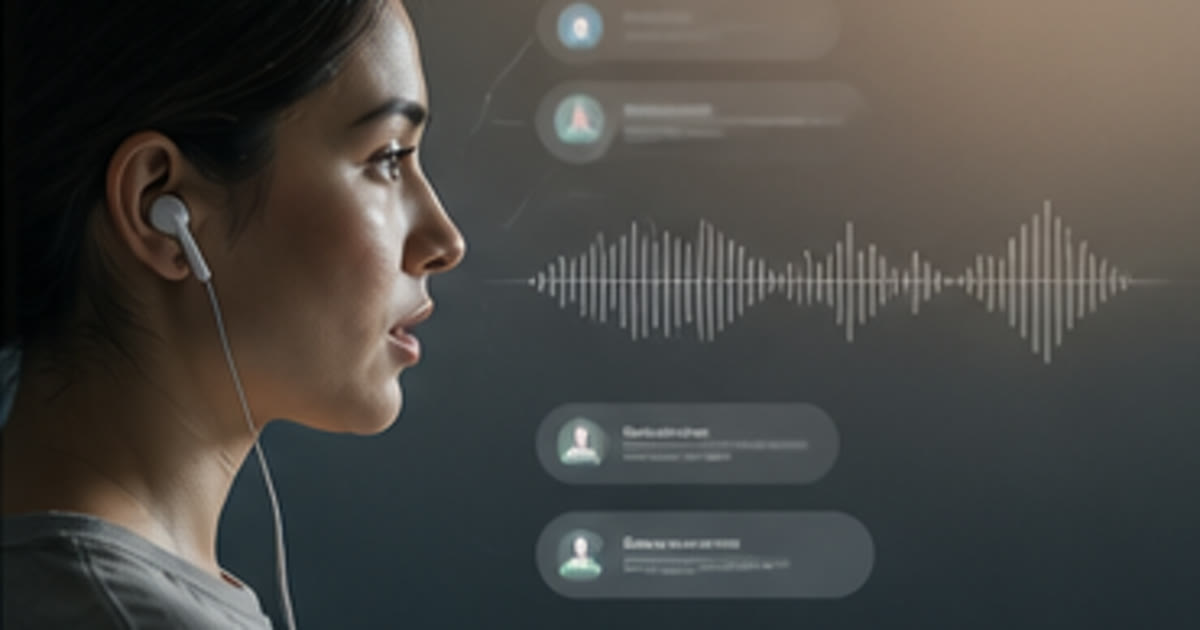
In September 2022, OpenAI released Whisper: a speech recognition model trained on a large, diverse corpus of audio across many languages and recording conditions. The technical story was accuracy and robustness. The more significant thing, for how we were thinking about CheekyGains at the time, was that it made voice input credible as a building block.
Before accurate speech-to-text, voice in consumer software was either a novelty or an engineering liability. Error rates were high enough that the correction overhead cancelled out the benefit. The result was that voice remained a feature nobody actually designed around: it was bolted on, optional, usually used by nobody.
When transcription becomes reliable enough that users stop thinking about it, the modality changes. Voice becomes an interface layer rather than a parlour trick. And that matters for performance coaching in a specific way: it changes what inputs are realistic to expect from people in the moments that actually matter.
Someone who has just had a hard session, or who is standing in the kitchen deciding whether to prepare food or order in, or who is lying in bed trying to assess how they feel: that person is not going to open an app and fill in a structured form. But they might say something out loud. Especially if they believe something useful will happen as a result.
"I slept badly, I've got a full day, I'm supposed to train this afternoon but I don't want to": that sentence takes five seconds to speak. It is not something anyone types into a logging field. And it contains exactly the kind of information a performance coach would want: current state, competing pressures, the fact that the person is still in enough contact with their intention that they reached for the system at all.
What matters is what happens next.
Naira as a design challenge
Naira is the AI performance coach inside CheekyGains. The name is simple. The design problem is not.
The tempting architecture is a language model with a well-organised fitness knowledge base, wrapped in a conversational interface. Ask Naira a question, get an informed answer. That is functional. It is also missing the point.
The person does not usually have a well-formed question. They have a situation. And the situation is messy, pressured, incompletely articulated, and often not the situation they think it is. What looks like a motivation problem is frequently a recovery problem. What looks like a discipline problem is frequently a target-setting problem. What looks like inconsistency is frequently a structural problem in how the week is designed.
A system that waits to be asked questions will be answered when things are calm and settled, exactly when coaching is least necessary. What is needed instead is a system that can receive imprecise, pressured, natural-language input at the moments when things are not settled, and respond in a way that is specific to the person and useful to the situation.
That is a harder architecture. It requires the system to maintain a model of the person over time, their standards, their history, the patterns in which they tend to struggle, and to use that model to interpret what is being shared right now. It requires knowing when to push back and when to give permission. It requires distinguishing between a pattern that needs confrontation and a single difficult day that needs acknowledgement.
Generic motivational content, the kind that fills the gap when a system does not have enough context to say anything specific, is not neutral. It actively damages trust. If someone shares that they are struggling and the system responds with a variation of "you've got this," they learn that the system does not understand them. After a few of those interactions, they stop sharing. The system loses access to exactly the inputs it needs to get better.
Accountability without the metaphors
Accountability is used loosely in the consumer fitness space. It tends to mean streak counters, progress rings, leaderboards, or social features where friends can see your activity. These are not accountability. They are gamification that borrows the language of accountability.
Real accountability is more specific and less comfortable. It involves a standard that was set, behaviour that departed from it, and a response to that departure that is calibrated to the circumstances. "You committed to training five days this week. You trained three. What happened on Wednesday?" is an accountability conversation. A broken ring is a UI metaphor for the idea of one.
The gap between these two things is where most coaching software lives. The system knows that a logged workout happened or did not. It does not know what the week felt like from the inside, what was traded off against the session, what the person told themselves to justify the decision. It cannot have a calibrated response to information it never received.
Voice input, used consistently at the actual moments of decision, starts to close this gap. Not because a transcription is equivalent to understanding, it is not, but because the raw material for understanding gets captured rather than lost. The system has something real to work with. And over time, across many such moments, it can start to see the patterns that a human coach would see.
The responsibility that comes with this access
A system that meets people in their uncertain, pressured, or compromised moments has a specific responsibility. It has access to states that most software never sees. That access is only warranted if the system does something useful with it.
Useful means specific. A response that could have been generated for anyone is not useful to the person who shared something particular. It is noise dressed up as support. The bar for an AI coach is not being encouraging. It is being calibrated, which requires having enough of a model of the person that what you say is actually for them.
This was the design problem in September 2022. Not "can we build a coach that knows about fitness?" but "can we build a coach that knows about this person?" The infrastructure for better inputs was arriving. The harder question was what the system would do with them.
Naira is an attempt to take that question seriously. Not in the product-marketing sense, not "personalised AI coaching" as a feature description, but in the sense of actually building something that earns trust by being specific, bounded, and honest enough to be worth talking to.
That is a high bar. This period of work was about understanding where the bar actually sits, and what it would take to consistently meet it.
---
Sources
- OpenAI, "Introducing Whisper," openai.com/index/whisper/ (September 2022)