Product
Orbit as a business operating system
Orbit as the business execution surface
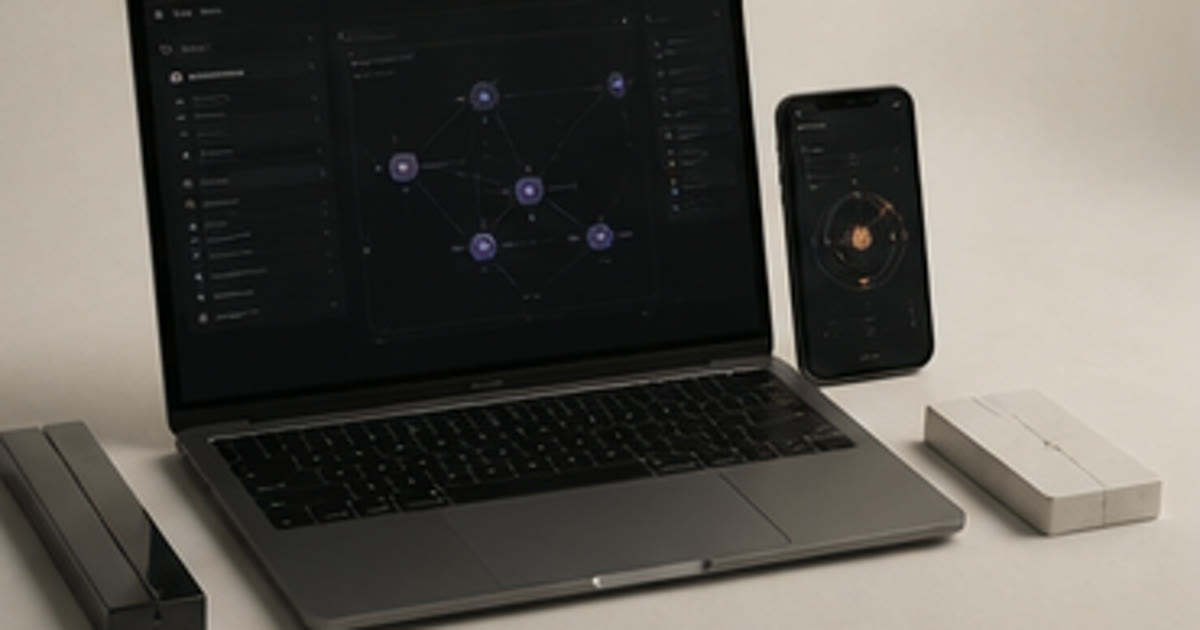
Not a metaphor
When people say "operating system" in a product context, they usually mean something aspirational and vague. A platform that does a lot. A suite of tools with a unified login. Something wide enough that the label becomes meaningless.
That is not what we mean when we apply it to Orbit.
The phrase earns its use here because of what a business actually needs to run, not in the abstract, but in the daily reality of commercial work. A business needs context: who are we talking to, what have we agreed, what is in progress. It needs memory: what was decided, what changed, why. It needs workflow: not task lists, but the actual sequence of steps that moves a thing from first contact to finished product. It needs intelligence: the capacity to flag what matters, surface what is relevant, and reduce the cognitive overhead of staying on top of a complex commercial pipeline. And it needs review: a consistent way of seeing whether things are progressing, stalling, or going wrong.
Most commercial software addresses one of those things in isolation. Orbit is built to hold all of them in one operating surface. That is the idea, and in March 2024, the shape of how it works has become considerably clearer.
What friction taught us
The useful product question this month is not "what can we build?" It is "where is the friction repeating?"
Repeated friction is a signal. It tells you where teams lose momentum, where people abandon the system they were supposed to follow, where the gap between how work should happen and how it actually happens becomes too large to close through effort alone. When that gap is large enough, people start keeping parallel records: a spreadsheet here, a notes app there, a shared document that nobody updates correctly. The system fragments. The memory of the organisation lives in the wrong places, updated inconsistently, trusted by nobody.
That observation is not new. But what is new, in this period, is the realistic possibility of building something that actually closes the gap rather than papering over it. The question is what form that closing should take.
The pattern we have observed across commercial environments is consistent: the problem is rarely a lack of information. It is a lack of connected information at the moment a decision needs to be made. A salesperson knows what was discussed in a first meeting. That context lives in a note somewhere. When they need it six weeks later, mid-proposal, the system either surfaces it or it does not. If it does not, if retrieving it requires manual work, switching applications, searching memory, the decision gets made with incomplete context. Sometimes that is fine. Often it is not.
Orbit is built around the assumption that context should be available without effort. That memory should be a product feature, not a personal habit. That the operating surface of a business should do the work of holding information in the right state so that people can focus on decisions rather than retrieval.
The full workflow, connected
The other way to understand Orbit is by tracing the workflow it covers.
A commercial engagement begins somewhere. A first conversation, an inbound enquiry, a referral. Before Orbit, that moment typically lives in someone's inbox or their head. It may or may not be logged. If it is logged, it may be in a CRM that the rest of the workflow has no awareness of, a system of record that is not a system of work. The deal advances; the proposal is written somewhere else; the scoping happens somewhere else again; the project gets handed off to a delivery team who start from scratch because the context from the commercial phase was never transferred.
The handoff is where work dies. It is the moment where everything that was learned during the lead process, the constraints, the preferences, the things that were almost dealbreakers, the unstated expectations, evaporates, because the system that held it was designed for one phase and not for what comes after.
Orbit's product surface is built to cover the full journey from first contact through to a launched product, without the information architecture collapsing at transition points. That does not mean it tries to be every tool at once. It means the connective tissue between phases is treated as a first-class concern, not an afterthought.
This is a harder problem than it looks. Different phases of commercial work have genuinely different requirements. The way information is structured during a lead conversation is not the same as the way it needs to be structured during project delivery. The skill is building transitions that preserve what matters without forcing uniform structure onto genuinely different contexts.
Intelligence as infrastructure
The AI layer, Orion, is not a feature bolt-on. It is the infrastructure that makes certain things possible at all.
Consider what it means to have memory across a complex commercial workflow. Not just storing records, but surfacing the right record in the right context, recognising when two pieces of information are related, identifying when a commitment made early in a relationship is relevant to something happening later. Doing that manually, across a growing number of relationships and projects, is cognitively expensive. Doing it systematically requires something more than a search function.
Orion handles the reasoning and retrieval work that sits underneath Orbit's operating surface. It is what allows context to be available without effort. It is what makes the difference between a system of record and a system that actually thinks with you.
The public framing of AI tools in early 2024 tends to emphasise generation: the capacity to produce text, images, code. That is genuinely significant. But for a product like Orbit, the more important capability is synthesis. The ability to take a body of existing information, conversations, documents, decisions, commitments, and make it usable in the moment. Generation is one part of the stack. Memory and reasoning are the harder problems, and the ones that matter more for commercial execution.
Services keep the work honest
TUXX sits alongside Orbit in the portfolio, and the relationship matters.
A services division that works in live client environments encounters failure in a way that a product-only operation does not. When you are delivering custom systems and the workflow breaks down, you learn exactly where the breakdown happens. You cannot abstract away from it. The constraint is real, the client is present, and the solution has to work in actual conditions rather than ideal ones.
That is why TUXX exists as part of the same system. Not as a revenue diversification play, not as a legacy business attached to a product company. As a mechanism for staying calibrated. The patterns that emerge in TUXX's client work, the points where even good teams lose context, where handoffs fail, where intelligence tools create more overhead than they reduce, feed directly into how Orbit is built.
Services expose problems. Research explains them. Products make the solutions repeatable. That is the logic of the portfolio, and it holds in both directions: Orbit informs how TUXX structures its engagements, and TUXX's experience informs how Orbit's product surface develops.
What the word "system" actually implies
A system, properly understood, is not a collection of features. It is a set of relationships between parts that produce behaviour none of the parts could produce alone.
That distinction matters for how Orbit should be evaluated. The relevant question is not whether any individual capability, the workflow tools, the memory layer, the intelligence that runs underneath, is impressive in isolation. The relevant question is whether the parts work together in a way that changes what is possible for the people using them.
In practice, that means the measure of Orbit is whether a commercial team operating with it can maintain higher-quality context across longer and more complex engagements than they could without it. Whether decisions get made with better information. Whether the distance between what was agreed and what gets delivered shrinks because the thread connecting them was never dropped.
These are not metrics that announce themselves clearly. They are the kind of improvements that show up as things-that-didn't-go-wrong, which makes them easy to undercount. Part of the discipline of building Orbit is being precise about what it is actually improving, not just what it makes easier to do.
Build where the pain repeats
The productive instruction, heading into the rest of this year, is straightforward enough to state and hard enough in practice.
Build the product where the pain repeats. Not where pain is theoretically possible, not where someone described a hypothetical scenario in which friction could arise, but where actual teams are actually losing momentum in ways that a better-designed surface would prevent.
Use AI where it genuinely improves the operating loop: where synthesis and memory and contextual reasoning change the outcome, not where they add a layer of complexity in exchange for modest convenience. And keep the system understandable enough for people to trust it. A commercial operating system that people cannot follow is one they will route around. The intelligence has to be legible enough that using the system feels like working with a capable tool, not delegating to a process nobody quite understands.
That combination, genuine capability, genuine usefulness, genuine understandability, is the standard the product is being held to. It is harder than any one of those things in isolation. It is the right standard, and March 2024 feels like a moment where the surface is mature enough to be held to it seriously.